
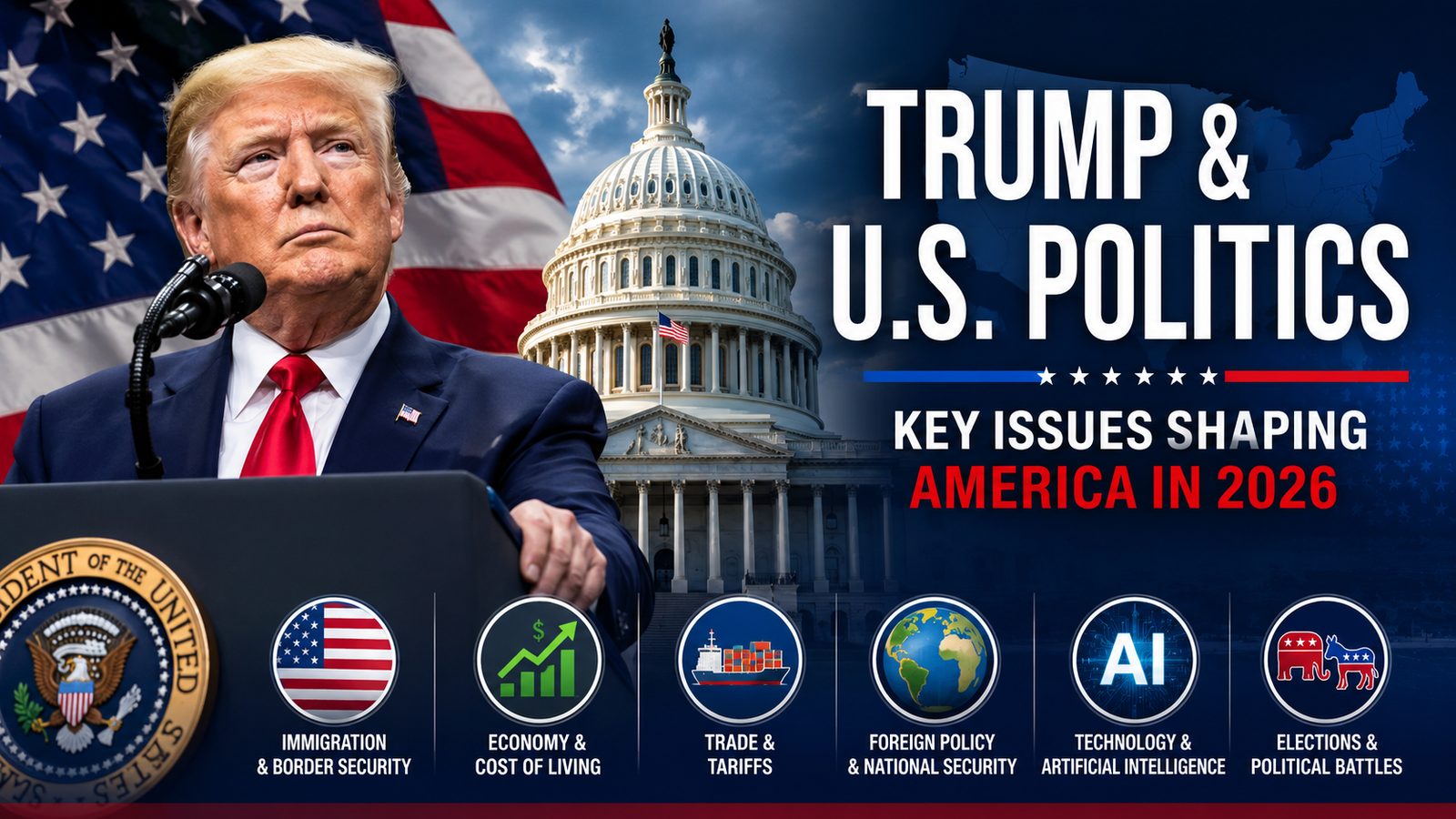
Trump & U.S. Politics remain at the center of America’s national conversation in 2026. President Donald Trump’s administration is facing major debates over immigration, tariffs, the economy, foreign policy, technology and the future of American elections.
With the 2026 midterm elections approaching, political decisions made in Washington are attracting even more attention. Republicans and Democrats are preparing for a major electoral battle, while voters are closely watching whether government policies are improving their everyday lives.
Here are seven major issues shaping U.S. politics right now.
1. Immigration and Border Security
Immigration remains one of the most important issues on Trump’s political agenda.
The administration has continued its crackdown on illegal immigration while also taking steps to restrict some forms of legal immigration. Recent policies have included increased immigration enforcement and proposals affecting visa programs.
Supporters of Trump’s approach argue that stronger enforcement is necessary to secure the border, reduce illegal immigration and protect national security.
Critics, however, argue that aggressive immigration restrictions can create humanitarian concerns and may also affect industries that depend on foreign workers.
The debate is unlikely to disappear soon, particularly as immigration remains an important issue for voters heading into the midterm elections.
2. Trump’s Tariffs and Trade Policy
Trade policy has become another defining feature of the Trump administration.
The White House has used tariffs as a tool to protect American industries, strengthen domestic supply chains and pressure foreign governments. In 2026, the administration has introduced or considered tariffs affecting a range of products and trading partners.
The administration argues that tariffs can encourage companies to manufacture more products in the United States and reduce dependence on overseas supply chains.
However, tariffs can also increase costs for businesses that rely on imported materials. Those higher costs can potentially reach consumers through higher prices.
The growing trade dispute with Canada illustrates how quickly tariff policy can become both an economic and political issue.
3. The U.S. Economy and Cost of Living
For many Americans, economic conditions remain more important than political headlines.
Inflation, housing costs, interest rates, employment, energy prices and household expenses continue to influence public opinion.
Recent economic reporting has pointed to slower hiring and continuing concerns about the cost of living.
This creates a major political challenge for the Trump administration.
Even if government policies produce strong results in some areas, voters may remain dissatisfied if groceries, housing, transportation and other everyday expenses remain expensive.
The economy could therefore become one of the most important factors in the 2026 elections.
4. Trump and the Federal Reserve
The relationship between the White House and the Federal Reserve is another important economic story.
President Trump has repeatedly favored lower interest rates, while the Federal Reserve’s leadership has emphasized controlling inflation and maintaining monetary stability.
Recent comments from Federal Reserve Chair Kevin Warsh have indicated a stronger focus on inflation risks, creating the possibility of continued tension over interest-rate policy.
The Federal Reserve operates independently of the White House, but its decisions have major consequences for mortgages, credit cards, businesses, investment and the broader U.S. economy.
For American consumers, the biggest question is how future interest-rate decisions will affect borrowing costs and economic growth.
5. Foreign Policy and America’s Global Role
Trump’s foreign policy is also shaping the political debate inside the United States.
Relations with countries such as China, Canada and nations in the Middle East are closely connected to trade, energy, national security and international diplomacy.
The administration’s approach has generally emphasized American interests and greater pressure on foreign governments.
At the same time, Trump’s policies have created concerns among some U.S. allies about the predictability of American economic and foreign policy. European central bankers, for example, have recently expressed concern about uncertainty surrounding U.S. economic cooperation.
Foreign policy therefore has consequences far beyond Washington. Changes in U.S. policy can influence global markets, energy prices and international relations.
6. Artificial Intelligence and Technology
Artificial intelligence is becoming an increasingly important political issue in America.
AI has the potential to transform industries, create new businesses and increase productivity. But it is also raising questions about jobs, privacy, copyright, cybersecurity and misinformation.
The political debate is increasingly focused on how the United States can encourage technological innovation without ignoring the risks associated with rapidly developing AI systems.
Technology policy could become particularly important because America’s position in the global AI race is closely connected to national security and economic competitiveness.
For policymakers, the challenge is finding the right balance between innovation and regulation.
7. The 2026 Midterm Elections
The 2026 midterm elections are one of the biggest political events on the U.S. calendar.
All 435 voting seats in the House of Representatives are scheduled to be contested, while dozens of Senate seats and governor positions are also at stake.
As the elections approach, Trump’s influence over Republican candidates remains a major political question. Some Republican candidates continue to closely associate themselves with Trump, while others in competitive races are attempting to emphasize their own political identity.
Election rules and voting procedures are also becoming major points of political disagreement. Trump and his allies have pushed for stricter requirements around voter eligibility and mail-in voting, while opponents have raised concerns about access to voting and election administration.
The results of the midterms could significantly affect the balance of power in Washington and determine how easily the administration can advance its legislative agenda.
Why Trump Remains Central to U.S. Politics
Even beyond individual policies, Trump continues to play an unusually influential role in the Republican Party.
His political movement has reshaped Republican priorities around immigration, trade, national security, government spending and the relationship between Washington and the states.
At the same time, his approval ratings and the public’s view of the economy remain important challenges for Republicans heading into the midterms. Recent polling has shown pressure on Trump’s approval numbers.
This means the 2026 elections could become a broader test of public opinion about Trump’s second-term agenda.
What Could Happen Next?
Several factors could determine the direction of U.S. politics during the rest of 2026.
The economy will remain critical. If inflation and employment conditions improve, the administration could gain political momentum. If household costs remain high or the labor market weakens, economic dissatisfaction could become a major electoral issue.
Immigration and trade will also remain important, particularly as new policies affect businesses, workers and consumers.
Meanwhile, foreign policy developments and technology regulation could create new political debates that were not central to earlier elections.
The 2026 midterms will ultimately provide one of the clearest tests of how Americans view the direction of the country.
Final Thoughts
Trump & U.S. Politics in 2026 are being shaped by much more than presidential statements and election campaigns.
Immigration, tariffs, the economy, Federal Reserve policy, foreign relations, artificial intelligence and the upcoming midterm elections are all connected to the broader debate over America’s future.
For voters, the most important question is likely to be whether government policies are producing tangible results in their daily lives.
As the 2026 political season develops, Americans will continue to debate the direction of the country, while the rest of the world watches closely.
BeWebStuff will continue to follow major developments in U.S. politics, technology, business and other trending stories from America and around the world.
Editorial Disclaimer
This article is intended for general informational purposes. U.S. political developments can change quickly, and policies, court decisions, economic conditions and election-related information may change after publication. Readers should consult multiple reliable and current sources for the latest developments.