

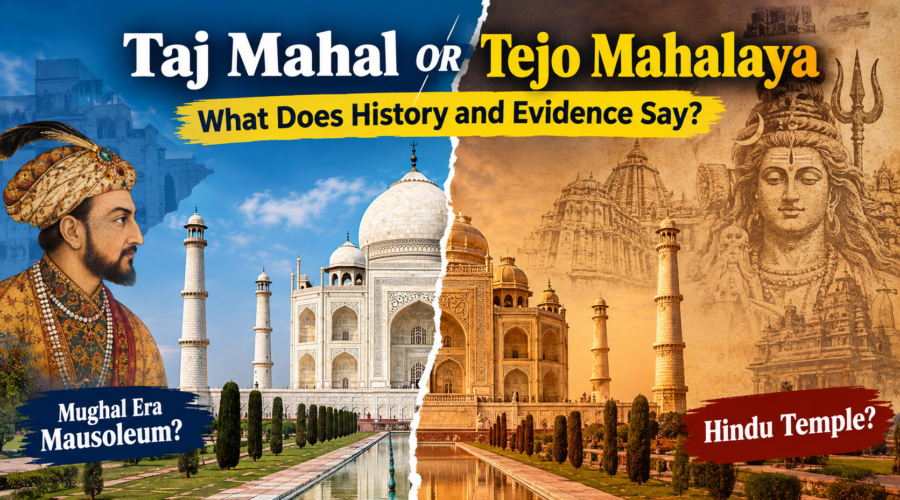
Taj Mahal or Tejo Mahalaya: Why Is There a Debate?
The Taj Mahal is one of the world’s most recognizable monuments and a major symbol of India’s architectural heritage. Built in Agra during the Mughal period, it is traditionally identified as a mausoleum commissioned by Mughal emperor Shah Jahan for his wife Mumtaz Mahal.
However, for decades, an alternative claim has circulated that the monument was originally a Hindu temple or palace called “Tejo Mahalaya.”
This claim has generated considerable public interest and debate, particularly on social media and in discussions about Indian history.
But what does the available historical evidence actually tell us?
The Traditional History of the Taj Mahal
The established historical account identifies the Taj Mahal as a Mughal-era mausoleum.
Shah Jahan commissioned the monument following the death of Mumtaz Mahal in 1631. Construction began in the 17th century, and the complex developed into the monument that exists today.
The Taj Mahal complex includes the famous white marble mausoleum, a large garden, a mosque, a corresponding building traditionally described as a jawab, gateways and other structures.
Its architectural style combines elements associated with Persian, Central Asian, Islamic and Indian traditions.
The monument is particularly famous for its symmetrical design, white Makrana marble, intricate decoration and large central dome.
What Is the “Tejo Mahalaya” Claim?
The term Tejo Mahalaya is associated with a theory that the Taj Mahal was originally a Hindu temple dedicated to Shiva and that the Mughal-era history of the building was later altered.
Supporters of the theory have pointed to architectural features, alleged historical references and interpretations of the monument’s name as reasons for questioning the conventional account.
The theory has become particularly popular in books, websites, videos and social-media discussions.
However, popularity of a historical theory does not by itself establish that the theory is historically proven.
What Evidence Supports the Conventional History?
Several types of historical evidence are commonly cited in support of the traditional identification of the Taj Mahal as a Mughal mausoleum.
1. Contemporary Mughal-Era Records
Historical documents from the Mughal period describe Shah Jahan’s building projects and the construction of the mausoleum for Mumtaz Mahal.
The Taj Mahal’s construction and patronage are therefore situated within a well-documented period of Mughal architectural activity.
2. European Travelers and Visitors
European travelers who visited India during and after the Mughal period also wrote about Agra and the monument.
Their accounts provide additional historical context for the Taj Mahal’s existence as a Mughal-era monument.
3. The Tombs and Mausoleum Design
The central building contains the cenotaphs associated with Mumtaz Mahal and Shah Jahan.
The overall organization of the complex—including the garden, mosque and mausoleum—also corresponds closely with the architectural traditions of Mughal funerary complexes.
4. Construction History
The monument is generally dated to the 17th century, with construction beginning after Mumtaz Mahal’s death and the principal complex developing during Shah Jahan’s reign.
This chronology is supported by multiple historical and architectural sources.
Why Do Some People Believe It Was Tejo Mahalaya?
The alternative theory has several recurring arguments.
Some proponents interpret certain architectural elements as evidence of a pre-existing Hindu structure. Others have questioned the origin of the name “Taj Mahal” and have suggested connections with the Sanskrit name “Tejo Mahalaya.”
There have also been claims involving rooms inside the monument, architectural symbols and alleged historical documents.
These arguments have attracted attention because the Taj Mahal contains a mixture of architectural traditions and because Indian history includes many examples of buildings being modified, reused or incorporated into later structures.
However, individual architectural similarities or interpretations do not necessarily establish the original identity of a monument.
Is “Tejo Mahalaya” Historically Proven?
Based on the mainstream historical and archaeological record, the claim that the Taj Mahal was originally a temple called Tejo Mahalaya is not established as a proven historical fact.
The widely accepted historical interpretation remains that Shah Jahan commissioned the Taj Mahal as a mausoleum for Mumtaz Mahal.
That does not mean historical research should never question established interpretations. Historians regularly examine old documents, architecture, inscriptions and archaeological evidence.
But a major historical claim requires strong, verifiable evidence rather than speculation or isolated similarities.
What About the Closed Rooms Inside the Taj Mahal?
Another frequently discussed part of the debate concerns rooms that are not normally open to visitors.
Some claims suggest that these areas contain evidence of a Hindu temple.
However, restricted or closed areas in historical monuments are not automatically evidence of a hidden religious structure. Historic buildings often contain inaccessible rooms because of preservation, structural concerns, security or the original design of the building.
Claims about these spaces therefore need to be evaluated through archaeological evidence and documented research rather than assumptions.
Taj Mahal Architecture and Hindu Influences
One reason the debate continues is that Indian architecture cannot always be divided into completely separate cultural categories.
Mughal architecture developed in the Indian subcontinent and incorporated local artistic and construction traditions.
The Taj Mahal contains decorative and architectural elements that reflect the broader artistic environment of India as well as Persian and Islamic traditions.
Architectural influence, however, is different from proving that a monument was originally built for an entirely different purpose.
Why the Debate Matters
The Taj Mahal debate is part of a larger conversation about how India’s history is interpreted.
Historical monuments can carry cultural, political and emotional significance for different communities.
For that reason, discussions about their origins can become highly sensitive.
The most reliable way to examine such questions is to compare:
- Contemporary historical records
- Archaeological evidence
- Inscriptions
- Architectural analysis
- Government and conservation records
- Scholarly research
- Primary historical sources
Social-media posts and viral videos can be useful starting points for questions, but they should not be treated as definitive historical evidence without verification.
Taj Mahal vs. Tejo Mahalaya: What We Know
| Question | Historical understanding |
|---|---|
| Where is the Taj Mahal? | Agra, Uttar Pradesh, India |
| Who commissioned it? | Mughal emperor Shah Jahan |
| Who was it built in memory of? | Mumtaz Mahal |
| Historical period | 17th century |
| Main material | White marble |
| “Tejo Mahalaya” theory | Alternative claim, not established as mainstream historical fact |
| UNESCO status | World Heritage Site |
| Main historical significance | Mughal-era mausoleum and architectural monument |
A Balanced Conclusion
The question “Taj Mahal or Tejo Mahalaya?” continues to attract attention because it combines architecture, history, religion and cultural identity.
The alternative Tejo Mahalaya theory remains a subject of public debate, but the established historical and archaeological interpretation identifies the Taj Mahal as a Mughal-era mausoleum commissioned by Shah Jahan for Mumtaz Mahal.
The best approach to controversial historical questions is neither to dismiss questions automatically nor to accept extraordinary claims without evidence.
Instead, historical claims should be tested against primary sources, archaeology, inscriptions, architecture and credible scholarly research.
The Taj Mahal remains an extraordinary monument regardless of the debate surrounding it—and understanding its history requires separating documented evidence from interpretation and speculation.
FAQs
Is the Taj Mahal actually Tejo Mahalaya?
The claim that the Taj Mahal was originally a Hindu temple called Tejo Mahalaya is an alternative historical theory. It is not established as the mainstream historical account.
Who built the Taj Mahal?
The Taj Mahal is traditionally attributed to Mughal emperor Shah Jahan, who commissioned the monument after the death of his wife Mumtaz Mahal.
When was the Taj Mahal built?
Construction began in the 17th century following Mumtaz Mahal’s death in 1631. The principal complex was developed during Shah Jahan’s reign.
Why is the Taj Mahal famous?
The Taj Mahal is famous for its white-marble architecture, symmetrical design, intricate decoration, large dome and historical significance.
Is Tejo Mahalaya a proven historical name for the Taj Mahal?
There is no broad scholarly consensus establishing “Tejo Mahalaya” as the original historical identity of the Taj Mahal.
Where is the Taj Mahal located?
The Taj Mahal is located in Agra, Uttar Pradesh, India.
Final Takeaway
The Taj Mahal or Tejo Mahalaya debate is an example of how historical questions can become part of modern cultural discussions.
For readers interested in the subject, the most important distinction is between a claim, evidence supporting a claim, and an established historical conclusion.
As new research and evidence emerge, historians can continue examining India’s monuments. Until then, the established historical record identifies the Taj Mahal as the Mughal mausoleum commissioned by Shah Jahan for Mumtaz Mahal.