
Published: September 7, 2026
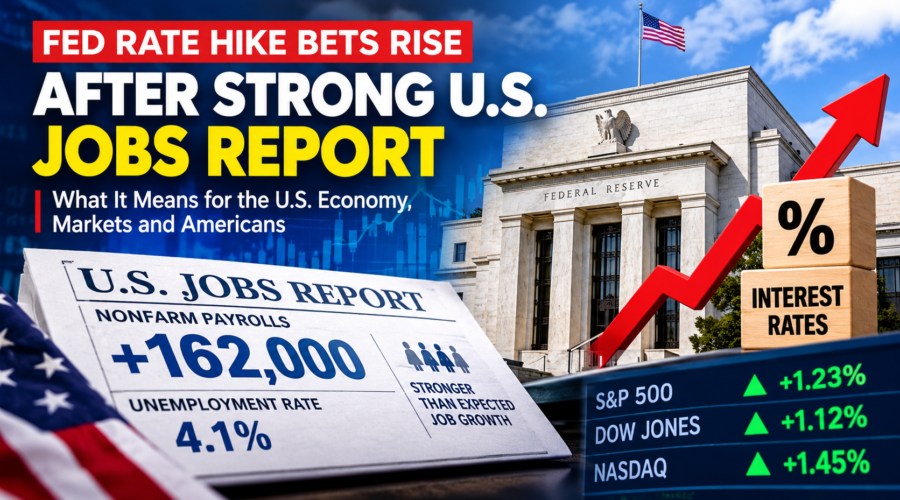
Financial markets are increasingly preparing for a possible Federal Reserve interest-rate hike this month after a surprisingly strong U.S. jobs report showed that the labor market regained momentum in August.
The U.S. economy added 162,000 nonfarm jobs in August, according to the Bureau of Labor Statistics, significantly above the average monthly gain of 31,000 recorded over the previous 12 months. The unemployment rate remained at 4.1%.
The stronger-than-expected employment numbers have changed the outlook for the Federal Reserve’s upcoming policy decision. Market pricing now places the probability of a September rate increase near 60%, although investors are waiting for fresh inflation data before making firm assumptions about the Fed’s next move.
Why the August Jobs Report Matters
The latest employment report delivered a stronger picture of the U.S. labor market than many economists had expected.
Payroll employment increased by 162,000 in August, while earlier estimates for June and July were also revised higher. June’s gain was revised from 20,000 to 31,000, while July moved from an initially reported 23,000 decline to a 21,000 increase. Combined, those revisions added another 55,000 jobs to the previous estimates.
The unemployment rate remained unchanged at 4.1%, while labor-force participation increased slightly to 61.6%.
Average hourly earnings also increased 0.3% during August. On a year-over-year basis, wages were up 3.1%.
Together, those numbers suggest that the labor market remains relatively resilient despite concerns about slower economic growth.
Strong Jobs Could Give the Fed More Room to Raise Rates
The Federal Reserve has to balance two major risks: inflation that remains too high and a labor market that could weaken if monetary policy becomes too restrictive.
A strong employment report reduces immediate pressure to cut interest rates. Instead, it gives policymakers more room to consider keeping rates high or even increasing them if inflation remains elevated.
Reuters reported that expectations for a September rate hike rose following the jobs report, with market pricing putting the probability around 57%.
That represents a meaningful change in investor expectations.
Before the latest jobs data, markets had been more focused on the possibility of monetary easing. The stronger employment numbers have forced traders to reconsider that outlook.
Inflation Data Is Now the Next Big Test
The jobs report may have shifted expectations, but it does not guarantee that the Fed will raise rates.
The next major factor will be inflation.
Investors are closely watching the upcoming Consumer Price Index (CPI) and Producer Price Index (PPI) reports for additional clues about the direction of monetary policy.
According to recent market analysis, economists expect headline August inflation to remain elevated, while core inflation could show some moderation. The Fed will be watching the underlying inflation trend carefully when it considers its September policy decision.
If inflation comes in hotter than expected, expectations for a rate hike could strengthen further.
If inflation is softer than expected, markets could once again begin pricing in a less aggressive Fed.
What a Fed Rate Hike Could Mean for Americans
A higher Federal Reserve policy rate can affect consumers and businesses in several ways.
1. Borrowing Costs Could Stay Higher
Higher interest rates generally make borrowing more expensive.
Consumers could continue to face elevated costs for:
- Credit cards
- Auto loans
- Personal loans
- Mortgages
- Other forms of consumer credit
For households already carrying debt, even a relatively small increase in borrowing costs can affect monthly budgets.
2. Savings Rates Could Remain Attractive
There is also a positive side for savers.
When interest rates remain high, banks and other financial institutions may offer relatively attractive yields on savings accounts, certificates of deposit and other interest-bearing products.
However, actual rates vary by financial institution and product.
3. Stock Markets Could Face More Pressure
Higher interest rates can create challenges for stocks because investors may demand higher returns from risky assets when safer interest-bearing investments become more attractive.
Growth-oriented companies can be particularly sensitive to changes in interest-rate expectations because higher rates can reduce the present value investors assign to future earnings.
The reaction is not always straightforward, however. A strong economy can also support corporate profits, which can offset some of the pressure created by higher rates.
4. The U.S. Dollar Could Strengthen
Higher U.S. interest-rate expectations can support the dollar by making dollar-denominated assets more attractive to international investors.
The dollar’s reaction has been relatively limited so far, partly because other central banks are also facing inflation pressures. Reuters reported that the dollar struggled to maintain its initial gains despite the increased expectations for a U.S. rate hike.
Gold and Bitcoin Are Also Feeling the Impact
Interest-rate expectations are affecting other major markets as well.
Gold prices declined after the stronger U.S. jobs report because higher interest rates can make non-yielding assets such as gold less attractive.
Reuters reported that spot gold fell around 0.6% on September 7, while traders increased the probability assigned to a September Fed rate hike.
Bitcoin has also faced renewed pressure as investors reassess the outlook for U.S. monetary policy. A stronger dollar and higher-rate expectations can create headwinds for risk-sensitive assets.
Which U.S. Industries Added Jobs?
The August employment report showed that job growth was not limited to a single sector.
Food services and drinking places added approximately 59,000 jobs, while local government education added about 42,000.
Manufacturing employment increased by 16,000, while healthcare added around 13,000 jobs.
At the same time, the information sector lost approximately 23,000 jobs, including losses in computing infrastructure, data processing, web hosting and related industries.
This mixed picture suggests that parts of the economy remain strong even as some industries experience pressure.
Does This Mean the Fed Will Definitely Raise Rates?
No.
The stronger jobs report has increased the possibility of a rate hike, but the Federal Reserve will consider multiple economic indicators before making its decision.
Inflation remains particularly important.
The Fed will also examine wage growth, consumer spending, economic growth, financial conditions and other labor-market indicators.
That means investors should be careful about treating market-implied probabilities as a guaranteed outcome.
A stronger-than-expected CPI report could push rate-hike expectations higher. Conversely, softer inflation could reduce the likelihood of an increase.
What Investors Should Watch This Week
Markets are entering an important period.
The biggest data points to watch include:
CPI inflation:
The August Consumer Price Index could significantly influence expectations for the September Fed meeting.
PPI inflation:
Producer prices can provide another indication of inflationary pressures moving through the economy.
Treasury yields:
Bond-market movements will provide clues about how investors are pricing future Fed policy.
U.S. dollar:
A stronger dollar could indicate increased expectations for higher U.S. interest rates.
Gold and Bitcoin:
Both assets could remain sensitive to changes in rate expectations.
Fed commentary:
Any comments from Federal Reserve officials could provide additional insight into the policy outlook.
The Bigger Picture for the U.S. Economy
The latest jobs report sends a complicated message.
On one hand, adding 162,000 jobs is a positive sign for the U.S. economy. The unemployment rate remains relatively stable, participation improved slightly, and wage growth continues.
On the other hand, stronger economic activity could make it more difficult for the Federal Reserve to justify rapid monetary easing if inflation remains above its target.
That puts the Fed in a difficult position.
Policymakers need to avoid allowing inflation to become entrenched while also making sure that interest rates do not unnecessarily weaken employment and economic growth.
Bottom Line
The August U.S. jobs report has put Fed rate hikes back at the center of the market conversation.
With payrolls rising by 162,000 and unemployment holding at 4.1%, the labor market appears stronger than many investors had anticipated.
Market expectations for a September rate increase have consequently risen to around 60%, but the final decision will depend heavily on incoming inflation data.
For American consumers, investors and businesses, the next few economic reports could therefore be critical.
The key question is no longer simply whether the U.S. economy is slowing.
It is whether the economy is still strong enough — and inflation still persistent enough — for the Federal Reserve to raise interest rates again.
FAQs
Why are Fed rate hike bets rising?
Fed rate-hike expectations increased after the August U.S. jobs report showed stronger-than-expected employment growth and a stable unemployment rate.
How many jobs did the U.S. add in August 2026?
The U.S. added 162,000 nonfarm jobs in August 2026, according to the Bureau of Labor Statistics.
What was the U.S. unemployment rate in August 2026?
The unemployment rate remained at 4.1% in August.
Will the Federal Reserve definitely raise rates in September?
No. A rate hike is not guaranteed. The Fed will consider inflation, employment and other economic indicators before making its decision.
What inflation data should investors watch?
The August CPI and PPI reports are among the most important upcoming economic releases for determining how markets view the Fed’s next move.
How could higher rates affect Americans?
Higher rates can increase borrowing costs for mortgages, credit cards and loans, while potentially providing better returns for some savers.